←
CATEGORY
Sourcing
READ
3 min
ISSUED
Wood moves with the air around it. In a Minneapolis house the indoor humidity can drop to around 20 percent in January and climb past 55 in July, and a floor that looked perfect in August can open gaps you could slide a coin into by February. Most of that is avoidable with four decisions made before the boards arrive.
Engineered or solid
On a slab, over radiant heat, or anywhere below grade, we specify engineered oak: a real oak wear layer over a stable core that moves far less. On a wood subfloor in a room with ordinary heating, solid oak is still our first choice, because it can be sanded and refinished many more times over the life of the house.
Narrower boards move less
Wide planks are popular, and each one moves more across its width than a narrow board does. For solid oak in a heated room we keep boards to five inches or less, and we choose rift or quartersawn stock where the budget allows, because it moves about half as much as plain sawn.
Let the boards acclimate
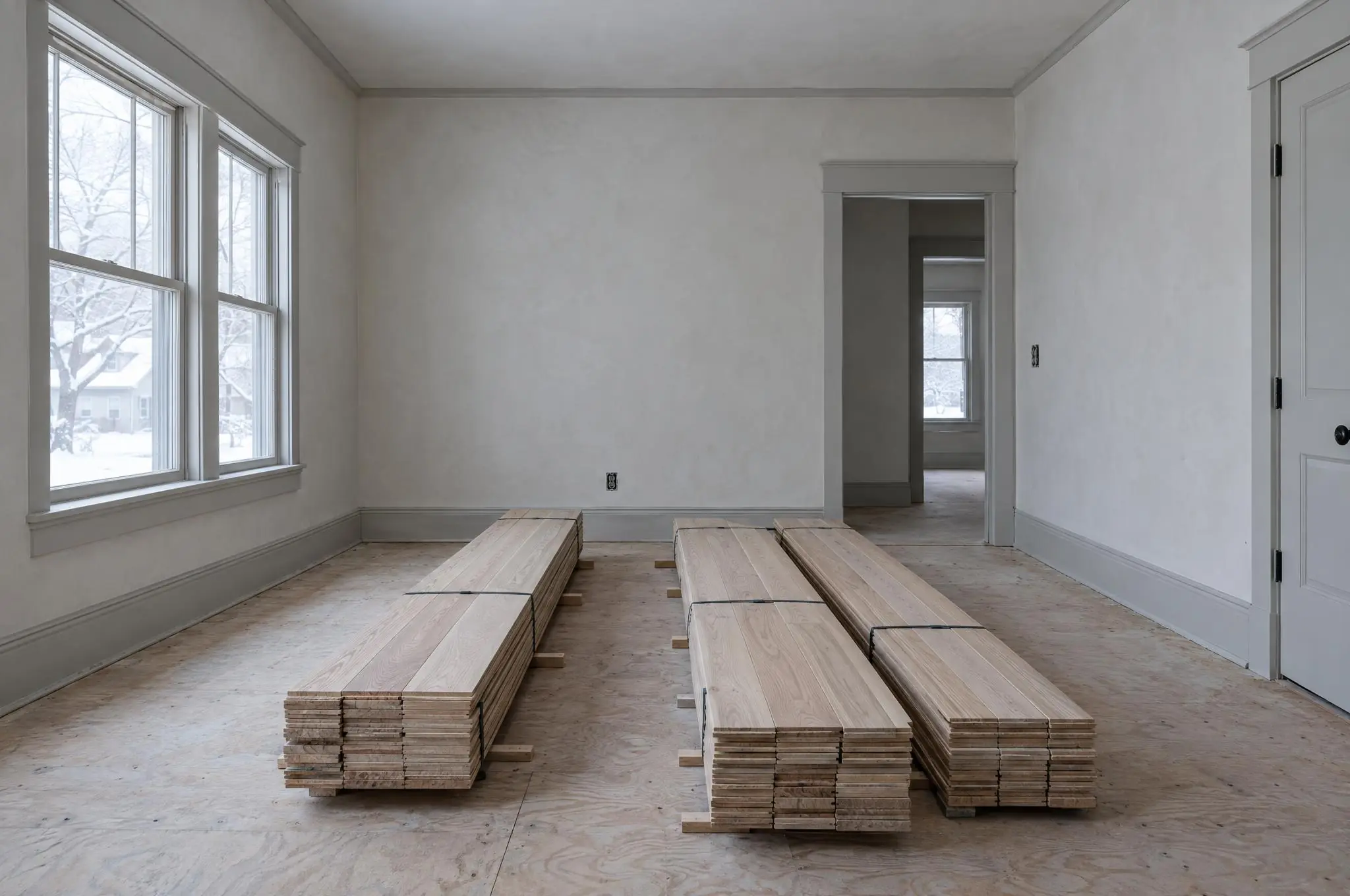
The boards should sit in the room they are going into, with the heat on and the windows in, for a week or more before anyone installs them. The installer checks the moisture of the boards and of the subfloor, and the two should be within a few percent of each other. We put that step in the finish schedule so it is not skipped when the calendar gets tight.
Run a humidifier in winter
The simplest protection costs very little: a whole-house humidifier set to keep the air around 35 to 40 percent through the winter. It is good for the floor, for the cabinet doors, and for the people living in the house.
None of this shows on a finished floor, which is why it is easy to skip. It is also why we write it into the drawings, right next to the floor itself.